By Joshua Stagg

Image courtesy of National Indigenous Times
As Australia ponders national reconciliation, John Howard is remembered as the man that refused to give an apology. The distaste for Howard embedded in Australian culture is, to an extent, warranted given his performance following the Mabo decisions. However, heed should be paid to some aspects of Howard’s words as Victoria enters the discussion of a treaty; this opportunity must not be wasted, we must learn from the past and not fall into the trap of kind intentions and empty words.
One of Howard’s primary concerns with the apology was that it would allow the settler decedents to claim they had ‘ticked the box’[1] and that reconciliation had been achieved. Arguably, he was correct in that little substantial progress has been made since, as Howard put it, Rudd’s ‘empty gesture’[2]. The Indigenous population of Australia left that speech feeling recognised, but nothing had fundamentally changed. Whilst it is generally agreed that it was of sentimental value, it did little else. The current mortality rates and deaths in custody are symptoms of an issue so deep and buried in Australia’s core that a three-minute speech doesn’t even scratch the surface, as is evidenced within each iteration of the Closing the Gap Report[3]. Whilst it is topical for members of Parliament to discuss this issue in the present political climate, there is one Prime Minister who has largely been forgotten by the younger generations, and yet, his contributions to attempting to right our nation’s wrongs are still as necessary and pressing as the day he entered Parliament. He was a prime minister that, despite his barely over three years in office, did more for the Aboriginal and Torres Strait Islander people than Kevin Rudd ever accomplished. It’s a dire state of affairs that I have, albeit anecdotally, found so few of my peers familiar with the name Paul Keating, let alone the name of the Redfern speech.
‘As Australia ponders national reconciliation…this opportunity must not be wasted, we must learn from the past and not fall into the trap of kind intentions and empty words’
Paul John Keating, the 24th prime minister of Australia, was born in Sydney in 1944. Keating never even finished high school, yet, he was arguably the most progressive prime minister to ever lead this country. Keating had taken the leadership from a disgruntled Bob Hawke: he had taken down the people’s favourite, the cultural icon. He was coming up to the next election, he, the man who left school at fifteen was up against Dr John Hewson, the leader of the Liberals with a PhD in economics. This was Keating’s life dream, Keating had shed blood and tears to reach this point.
The Mabo decision was a pivotal moment in Australian history, but as with all turning points in a culture, there are those that saw it as a threat. Keating was still new to the office and it would have been understandable for him to cater to the whims of the people. Instead, Keating went against the grain and praised the decision. Keating’s radio interview on 2UE Talk Back Radio in 1992 stands as evidence of his belief in the then present, and still continuing, injustice being done to the Indigenous people of Australia. The interview featured call-ins from various Australians to talk to Keating about Mabo. Three people called into the show, and all of them attacked Keating for his position on Mabo. One man stated that Keating was ‘allowing a total waste of [public] funds‘[4] by facilitating Aboriginal and Torres Strait Islander peoples making claims on the land. In response to this, Keating stated that white Australians were allowed legal aid, why shouldn’t the original inhabitants of this land get the same right? The man continues to grow angry to which Keating retorts ‘Look…I’m not here…to soak up all your prejudices’[5]. Keating gets progressively frustrated throughout the interview and in response to a man stating that he was ‘not a racist, but’[6]Keating interjects with ‘that’s what they all say, don’t they? … [T]hey always say I’m not racist, but’.[7] Keating, in a taste of what would become the Redfern speech, stated that the Mabo decision was a chance for the Indigenous people of Australia to finally get the same rights as everyone else. He stated that ‘it’s not a case of discrimination in favour of Aboriginal people, it’s a case of bringing them up to rights which…non-aboriginal Australians have enjoyed.’[8] This interview gives a telling example of public sentiment as Keating approached the ‘unwinnable’ election. And it was in this environment that Keating delivered the Redfern speech.
The Redfern Speech was delivered on the 10th of December 1992 in Redfern. Paul Keating stepped up to the microphone, a mere six months after the Mabo decision; Australia was in near hysteria over Aboriginal claims to land. John Howard, in his hunger for a Coalition government, set out to scaremonger amongst people that failed to understand Mabo by holding up a map of Australia and saying that Labor was going to let ‘the Aboriginal people of Australia … have the potential right to veto over further development of 78% of the land mass of Australia’.[9] People were scared, tension was at breaking point. Keating had been ridiculed and verbally abused on national radio, he had been called a racist towards white people. If ever there was a moment to speak to the public’s fears and to galvanise the people of Australia behind a cause, this was it, he could use these land claims as a common enemy amongst white Australia, all Keating had to do was play into the public’s fear and he might just win the upcoming election. And yet he cleared his throat and, instead of giving the speech that Australian wanted, he gave the speech that Australia needed:
‘We took the traditional lands and smashed the traditional way of life.
We brought the diseases. The alcohol.
We took the children from their mothers.
We practised discrimination and exclusion.
It was our ignorance and our prejudice.
And our failure to imagine these things being done to us.’[10]
Paul Keating, the man who the present generation has apparently forgotten, made these comments because he saw the crime rates and alcohol problems of Indigenous Australians for what they were; a byproduct of the continuing racism that has become embedded in Australian culture. Keating discussed the deaths in custody, further, he urged action. He stated that ‘[d]own the years, there has been no shortage of guilt, but it has not produced the responses we need. Guilt is not a very constructive emotion.’[11]And he was correct, guilt means nothing in isolation. Keating advocated for the ‘things which must be done – the practical things’,[12] he did not simply echo the same platitudes that have filled Indigenous ears for generations, he urged that change was needed. Further, Keating advocated that the Mabo judgement should be seen as an invaluable turning point for a new relationship between indigenous and settler-descended Australians. The Mabo decision should be seen as a building block of change by ‘doing away with the bizarre conceit that this continent had no owners prior to the settlement of Europeans, Mabo establishes a fundamental truth and lays the basis for justice.’[13]
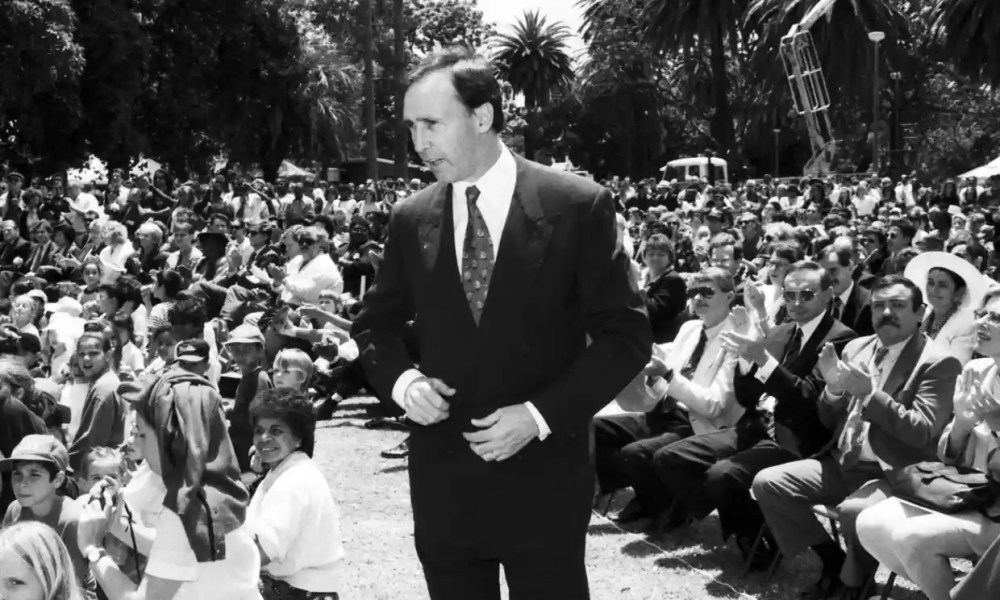
Image Courtesy of The Guardian
Keating was driven, Keating was unrelenting on this issue to the point of ridicule. Following the Mabo decision, Keating pushed for it to be enshrined into legislation. However, it can not be overstated that Keating’s actions were incompatible with the zeitgeist of the 1990s. Keating’s speechwriter, Don Watson, stated that ‘[d]esigning a legislative response to Mabo was a moral imperative and a political deathtrap … [with] all the elements of political horror’.[14] Despite this, Keating managed to draft and pass the Native Title Act 1993 (Cth) which provided a national foundation for the recognition and protection of native title across the Commonwealth.
Keating was beaten by the Liberal John Howard at the 1996 election. Keating, the prime minister that prioritised Indigenous rights over his career’s longevity was discarded by settler Australians: we, as a country, chose the status quo. In a time when progress was being made, the average Australian gave into fear and voted for the conservatives. As Victoria progresses through treaty negotiations and Australia approaches the referendum for the Voice, the younger generation must look back to Keating and pay heed to his words and actions. This presents an opportunity to fix one of the largest issues that continues to plague modern Australia. It festers in the corner of our psyche. We must do all we can to embody the sentiments expressed by Keating in the Redfern speech.
[1] Anne Davies, Nothing to say sorry for: Howard (Article, March 2008), https://www.smh.com.au/national/nothing-to-say-sorry-for-howard-20080312-gds4t6.html
[2] Shuba Krishnan, John Howard has criticised Kevin Rudd’s 2008 apology to the Stolen Generations (Article, 1 January 2022)
[3] Australian Government, Commonwealth Closing the Gap Annual Report, Report (2022)
[4] ‘Keating on Mabo’, (2UE, 1992) 5:09 – 5:15
[5] Ibid 5:27
[6] ‘Keating on Mabo’, (2UE, 1992) 11:26
[7] Ibid 11:29 – 11:31
[8] ‘Keating on Mabo’, (2UE, 1992) 16:00 – 16:18
[9] ‘John Howard’s response to the Mabo and Wik decisions, 1996’, 7:30 Report (ABC, 1996) 0:05 – 0:20
[10] Paul J Keating, The Redfern Speech (Speech, 10 December 1992) 4790 4792
[11] Ibid 4792 – 4793
[12] Paul J Keating, The Redfern Speech (Speech, 10 December 1992) 4790 4793
[13] Ibid
[14] Don Watson, Recollections of a Bleeding Heart: A portrait of Paul Keating PM (Vintage Books Australia, 2002).
 purelydicta.com
Leave a comment