Patrick Irwin – Editor, Purely Dicta
Few Australians know that they could be sent to jail with no trial. We take for granted the right that the government cannot whisk us into custody with no pretence and no warning.
But our own Constitution allows for just that. Section 49 provides that the Parliament has the same powers and privileges as the UK House of Commons had at the time of the Commonwealth’s formation.
This power – surprisingly enough – has been held to extend so far as to allow the Parliament to send ordinary members of the public to jail, without any real judicial process.
The 1955 Privilege case
This power has only been exercised once in Australian history, by the House of Representatives.
On the 3rd of May 1955, Charles Morgan, the Labor member for Reid in Sydney, informed Parliament that an article appearing in the Bankstown Observer on 28 April 1955 had impugned his personal honour and challenged his fitness to be a Member of Parliament.
The article followed a long-running dispute between Morgan and the paper’s owner, Raymond Fitzpatrick. It essentially alleged that the member had been and was still involved in an illegal immigration scheme advertising guaranteed entry into the country in exchange for kickbacks. Frank Browne had been hired to write this and other articles attacking Morgan and was a ‘scandalous journalist known to ASIO for engaging in blackmail’.
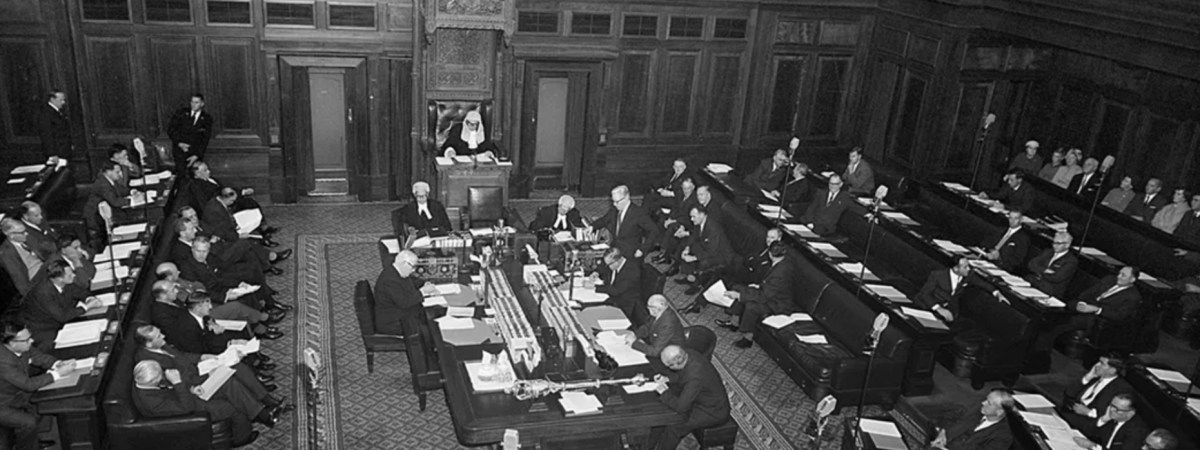
The House of Representatives which Fitzpatrick and Browne confronted: Museum of Australian Democracy
The men were brought before the bar of the House – the bronze bar which gated the entry to the House of Representatives in Old Parliament house.
There, they were asked to explain themselves. Fitzpatrick was denied the opportunity to be represented by his counsel because the resolution of the House had only called upon the two men to speak by name, not their representatives. Browne delivered a lengthy defence with which one cannot help but feel sympathy:
Now, Mr. Speaker, let me ask you how what has happened to me this week squares up with that. First, I have been convicted and never charged. Secondly, at no time have I had legal representation. Thirdly, the case against me has not been properly proved. Fourthly, I have never had the right to cross-examine my accuser. And fifthly, I have no right to appeal.
Despite their pleadings, the Cabinet decided that the two men should be jailed for 90 days, and the House sentenced them on Prime Minister Robert Menzies’ motion.
The House’s ruling was later upheld by the High Court on the basis that it is a matter for the Parliament to determine for itself what constitutes contempt of Parliament, so long as it is on its face consistent with a breach of privilege.
The case for reform
Junior counsel for the men and later Chief Justice of the High Court, Sir Anthony Mason, was incensed at the denial of due process, declaring later in life that his ‘sense of outrage over Parliament’s denial of due process and natural justice remains undimmed after a lapse of 40 years.
It is extremely difficult to reconcile Parliament’s ruling with accepted constitutional principles. No court could ever sentence an accused so summarily and without a formal indictment. Parliament’s ability to determine matters of contempt for itself is inconsistent with four key principles:
- Separation of powers – sentencing and punishment are accepted to be judicial functions, confirmed by the Boilermakers doctrine to be only exercisable by a Ch III court. There are obvious problems with the neutrality of a political body such as Parliament, particularly when judging someone who has criticised one of its members.
- The presumption of innocence – there is no obligation for Parliament to presume innocence of an accused or find their guilt to any standard of proof, let alone reasonable doubt.
- Natural justice – if the relevant house decides, a person may have no right at all to advocate on their own behalf nor have their lawyer address the house.
- Bicameralism – The government-controlled House or Senate can find a contempt of Parliament with no oversight or check from the other house.
The procedure for contempt of Parliament bears no resemblance to any other judicial process. It is an aberration to justice and could, if abused by the government of the day, be a charter for despotism.
Reform is clearly needed. An independent judicial inquiry should be held into the wording of a possible constitutional reform, and bipartisan support sought from the major parties for a Yes case.
References and Further Reading
Robert Menzies Institute. (n.d.). The Browne-Fitzpatrick privilege case. Robert Menzies Institute.https://www.robertmenziesinstitute.org.au/on-this-day/the-browne-fitzpatri ck-privilege-case-3/
Sydney Morning Herald, 11 June 1955: http://www.austlii.edu.au/au/journals/AboutHouseMag/2001/8.pdf
R v Richards; Ex parte Fitzpatrick and Browne [1955] HCA 36; 92 CLR 157
 purelydicta.com
Leave a comment