By Johnny Nguyen
April 8 2025
Miss Honey from Matilda, Professor Snape from the Harry Potter series, Mr Anderson from the Perks of Being a Wallflower. Teachers are the unsung architects of our futures. They shape our hearts, mould our minds, and encourage us to pursue our lofty aspirations.
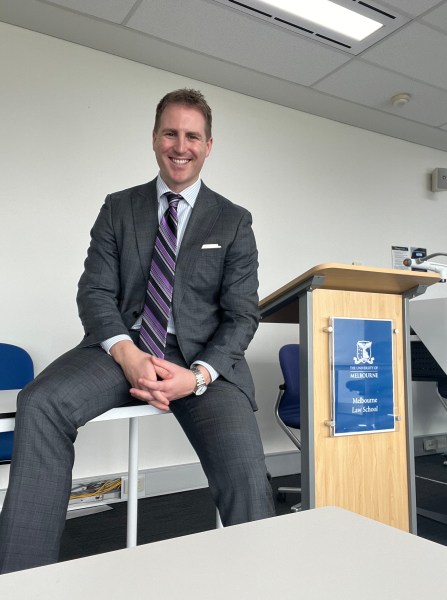
When I had the chance to select a teacher to interview, the choice was simple: Samuel J. Woff. Sam came to Melbourne Law School in 2023, entering with a distinguished career in construction law at some of Australia’s top law firms. He taught me Contracts, but also teaches LMR, Obligations and Construction Law.
Every teacher at Melbourne Law School is brilliant in their field. So, what made Sam stand out? His genuine desire to get to know each and every one of his students. Sam shared his motivations for cultivating such strong bonds with his students:
“When I was at law school, I didn’t feel that same connection with my lecturers. I met some amazing people there, and I’m still friends with them, but I felt like just another anonymous attendee in a lecture hall. It wouldn’t matter if I was there or not, if I tried or not.”
“If a teacher knows your name, you feel more connected, more engaged… University is inherently different from the intimacy of high school, but I try to break down that barrier and make my students feel like they’re part of something.”
We also discussed some hard lessons Sam learned at law school. As a JD1 at MLS, we arrive at the beginning of the year for LMR, bright-eyed, fresh, eager. Maybe even confident. But then the assessments roll in, the comparisons to our peers take hold, and we often feel like we are tossed around on the highest setting of a washing machine, spinning furiously with little control. I wanted to explore this theme with Sam – the importance of resilience and picking yourself up, and above all, how to find validation through other means than academia.
Sam spoke with such candour and shared the following:
“When you come from a high-performing background, academic achievement often becomes your primary source of self-esteem. When you’re doing well, you feel good. When you’re not, you feel like you’ve failed—not just academically, but as a person.”
“That external validation I’d always relied on disappeared. It forced me to rebuild my sense of worth from scratch. It’s something I think a lot of law students quietly wrestle with: recalibrating your understanding of your value beyond the marks and awards… At the time, it felt like failure—but now I can see it wasn’t a failure at all, just a hard lesson in self-worth.”
“Law school is filled with these moments where we mask our struggles because we’re all so focused on projecting the best version of ourselves. I did it, too. We suppress our inadequacies, and that’s understandable. If I could go back in time and speak to my younger self, I’d say, “It’s okay, Sam. You’re doing well. Law is hard, and just finishing this degree is an accomplishment. The difference between your 63 and someone else’s 83 is microscopic in the grand scheme of things. Don’t fret. You’re doing fine.”
Sam’s reflections, to me, embody a sage conception of success and failure – one that I aspire to reach. It is an understanding that success is not inherently defined by an unbridled string of academic triumphs, but as a more nuanced understanding of self-worth that transcends external accolades and grades. His comments remind us that we should embrace and be proud of our failures and shortcomings, rather than feel the need to embellish them with superficially shiny patinas.
What struck me most about our interview was Sam’s response to this question: “What are you most proud of in your life, Sam?” I sat there, waiting to hear more about his illustrious career at big law firms or more about his recently published book on the process of modern litigation.
Instead, he replied, “Being married to my wife, Jenny. That’s the best thing that’s ever happened to me.”
Firstly, let’s all find it in our hearts to forgive Sam for setting the bar so high and making us all look bad. But secondly, what a beautifully profound response.
At law school, we often lose sight of who we are and what truly matters to us. Sam’s response reminded me of what is truly important in life: not an astronomically high WAM, a competition win, or some shiny job. It is love, relationships, and connections that make this life meaningful and truly worth savouring.
And finally, for you, Purely Dicta, I had to address the elephant in the room: Sam’s LinkedIn. Week in and week out, he graces our feeds with excerpts from his book, highlights from his classroom, and photographs of his public speaking events.
He shared some insights on how to be a LinkedIn Legend:
“It got drilled into me early in my career that there are 66,000 practising solicitors in Victoria, and it’s very easy to get lost in the crowd if you don’t work hard at maintaining a public profile. So that was always important in private practice, because law firms are always trying to find new clients, and you can’t do that by being anonymous.”
“I’m glad that it looks like there’s a method to the madness, but there absolutely is not. I very much post on instinct… I don’t have a marketing mindset. I don’t have a structure to it at all. I just think, “What’s something interesting to share today? What have I been up to? What am I thinking?” and I just go ahead and post.”
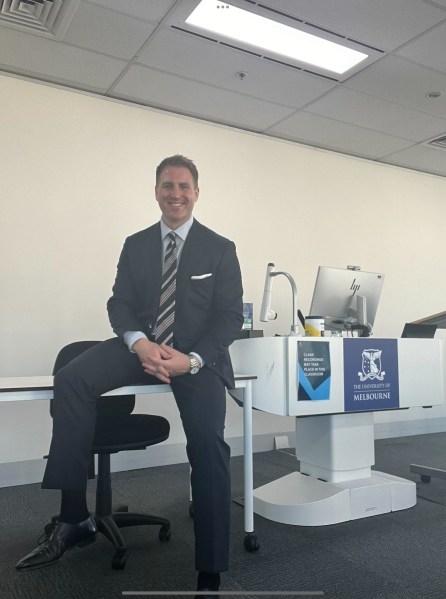
I also asked Sam about if he uses a selfie stick, or has someone take his pictures for him.
“I do not have a selfie stick. I prop my phone up on a water bottle and set the timer to 10 seconds, so it’s very low-tech. Maybe I should invest in a selfie stick, but I haven’t yet bitten that bullet.”
Ultimately, Sam’s story is not one of effortless, prodigious success. It is one of quiet, yet dogged determination. He navigated the transition from feeling anonymous in a large and overwhelming lecture hall to becoming the kind of lecturer who makes the effort to remember your name, to ask you if you are okay on “R U Okay? Day”.
Interviewing Sam reminded me about the importance of surrendering perfectionism and embracing the wildly messy, painful, yet exquisite process of becoming.
Maybe that’s what law school is truly about. It is not just a long, exhausting, difficult degree, but a crucible where our best parts are forged, and reforged under excruciating pressure.
And if you’re fortunate, a teacher like Sam—or even your own inner voice—will remind you, amidst the trials, “It’s OK. You’re doing well.”
 purelydicta.com
Leave a comment