Thought Kim broke the Internet? The age of biometric morality is here.

By Le Somnambule
“Age assurance.” A neat, bureaucratic shorthand for a sweeping shift in how Australians will soon access the internet. It sounds reasonable: a way to keep children safe from online harms. Yet beneath the surface, unfolding across Australia is something far larger: a quiet transformation of the web from an open commons into a gated archive. Entry by ID only.
Je suis Le Somnambule. So called because I speak from the spaces that are slowly vanishing — the anonymous, the peripheral, the unverified. I am watching governments promise safety while building systems of control. What’s happening in Australia now follows a familiar script: frame the internet as dangerous, children as at risk, and surveillance as the only solution.[1]
The federal government has been trialling technologies that estimate age by scanning your face. Others ask for your driver’s licence, your passport, your credit card. When these tools are implemented, they will decide whether you can access social media, pornography, gambling sites, or even health information. The aim, we’re told, is to protect minors. But the consequences go far beyond that.
Because when access depends on identity, anonymity becomes deviance. And when everything you do is linked to your face, your age, your payment details — what remains of free speech?
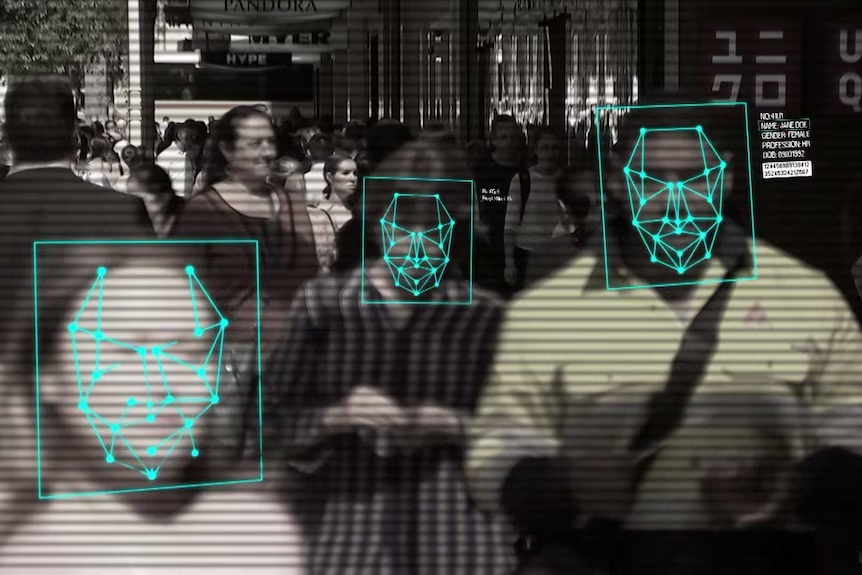
This article is not about defending pornography. It is about defending the right to explore, to ask, to speak — without needing to be seen. It is about recognising the political interests driving these changes: media companies, betting giants, and governments eager to regulate without taking responsibility. And it is about understanding what we lose when we trade frictionless access for digital checkpoints.
The tools being built today will not remain confined to their original purpose. They never do. That’s why I’m writing this now. Before the gates close.
An Open Web, Slowly Sealed
In May 2024, the Albanese government announced a $6.5 million pilot to test age assurance technologies — including facial scans and biometric estimation — for designated online platforms.[2] The legislated plan now includes requirements that ban children under 16 from social media altogether, to be enforced through digital identity checks.[3]
Australia’s eSafety Commissioner, Julie Inman Grant, already holds the power to unilaterally issue removal notices for material considered harmful or inappropriate — a regulatory model that critics say lacks transparency and judicial oversight.[4]
Though these measures are framed as protective, they often exclude the very young people they claim to serve. Researchers Zahra Stardust and Alan McKee explain how age verification technologies are more likely to exclude young people, especially those who are most vulnerable or marginalised, from accessing important information and resources — rather than protecting them.[5]
More practically, one participant in recent trials, a 15-year-old student, was mis-aged four different ways: “19, 37, 26 and I think it was 23 as well”.[6] Good stuff.
Safety or Strategy?
This push toward identity-gated access didn’t emerge in a vacuum. Funnily, in fact, it closely followed the federal government’s decision to ignore key recommendations from its own gambling reform inquiry.
In June 2023, a bipartisan parliamentary committee chaired by MP Peta Murphy recommended a blanket ban on gambling advertisements, noting that children were being exposed to “saturation levels of marketing”.[7] The government, under pressure from media and sporting interests, shelved the idea.
Instead, the gambling lobby proposed an alternative: use age verification technologies to block minors from sports betting sites — and leave advertising untouched.[8] Sources within the industry successfully urged the government to adopt facial verification and ID scans as “a way to protect kids” without hurting revenue models tied to ads.[9]
Tim Costello, Chief Advocate for the Alliance for Gambling Reform, was blunt: “They continue to fail to explain why we’ve got the greatest gambling losses in the world, but keep fiddling at the edges to keep the sporting codes and media outlets onside”.[10]
Thus, a system originally framed as a way to protect children from pornography has been reframed — by lobbyists — as a tool to protect industry profits.

Anonymity Is Not the Enemy
Beneath all the rhetoric about safety lies a deeper truth: anonymity is not a threat to be eliminated, but a refuge to be protected. For many young people, especially those exploring gender, sexuality, mental health, or trauma, anonymous access is a lifeline.
Sexuality is a normal part of development, and it is known that young people actively seek out online resources to understand their own identities, bodies, and experiences.[11]
But age verification gates do not distinguish between explicit content and educational material. In jurisdictions that have implemented similar measures, such as the UK, platforms like Reddit have pre-emptively blocked access to dozens of subreddits, including r/SexualAssault, r/StopSmoking and r/StopDrinking, because they contain “mature content”.[12]
These aren’t pornographic spaces. They’re support groups. And the net effect is not safety — it is silence.
The Illusion of Safety
Even if these tools worked perfectly — which they demonstrably do not — the broader risks would remain. Systems that verify age must store or process identity data. And wherever data is stored, it can be breached.
Tying sensitive information to identity may put young people at risk of criminalisation, surveillance or data exploitation. Such concerns are not theoretical: verification platforms such as that used on Tea, a viral dating safety app for women, have already leaked tens of thousands of user IDs and biometric photos.[13]
Meanwhile, teens adapt faster than any system can constrain them. During the UK’s verification rollout, VPN usage among minors spiked as soon as porn filters were introduced — a clear sign that restrictive tech simply drives behaviour underground.[14]
Face Scans and Function Creep
Perhaps most concerning is how rapidly these systems expand beyond their original mandate. Today, they’re being deployed for social media, porn, and gambling. Tomorrow, they may be applied to news, artistic expression, political activism — anything with an “age-sensitive” label.
With the same technology designed to gate children from TikTok quietly repurposed to serve the interests of the gambling industry,[15] it is easy to see age verification becoming the Swiss Army knife of digital censorship.
Once the infrastructure for universal identification is in place, its scope is limited only by policy, or lack thereof.[16]
The Two-Tiered Web
The result is a fragmented, two-tiered internet. One tier — sleek, official, verified — will be accessible to those willing and able to submit their identities, and inevitably paid for by the lucrative advertising data to be gleaned. The other — glitchy, shadowy, anonymous — will be blocked, throttled, or criminalised.
For those who can’t verify — undocumented youth, trans people without matching IDs, kids in unsafe homes — the consequences are profound. Not only do they lose access to essential information, but they are branded suspicious for even trying to seek it.
This is not safety. It is exclusion.
Nameless, Not Silent

I walk not in sleep, but in protest.
Someone must. Because while politicians speak confidently of “safety,” they build systems that sort citizens by compliance: scanned or suspect, verified or voiceless. Because behind every firewall erected in a child’s name, there is a lobbyist, a loophole.
They say this is about protecting children. But they are building a regime that protects no one and excludes many. The teen who needs answers they can’t ask out loud. The closeted kid looking for their language. The trans youth without matching ID. The victim-survivor unwilling to link their name to their story. They will not pass the gate.
They are not threats. They are citizens. And they are being locked out.
The architecture of safety is being built by people who’ve forgotten what it means to need a place without judgment — a place to ask without being watched. Somewhere to remain nameless.
Not all who hide are hiding something shameful. Some are hiding because it’s the only way they’ve ever been safe.
Je suis Le Somnambule — the sleepwalker. Moving through a world that prefers its subjects visible, tagged, and quiet.
Sad. A little bit drunk. Perhaps regrettably smoking a cigarette in my naïve, youthful defiance. I keep walking because someone must remember what freedom looked like before it required permission.
I walk because their systems demand stillness, and I still have breath.
[1] Alex Skopic, ‘Britain Is Losing Its Free Speech, and America Could Be Next’ (31 July 2025) Current Affairs https://www.currentaffairs.org/news/britain-is-losing-its-free-speech-and-america-could-be-next.
[2] Justine Humphry, ‘Age Verification for Social Media: Do Kids and Parents Even Want It?’ (23 May 2024) Sydney University News & Opinion https://www.sydney.edu.au/news-opinion/news/2024/05/23/age-verification-social-media-do-kids-parents-want-it-expert.html.
[3] Department of Infrastructure, Transport, Regional Development, Communications and the Arts (Cth) and eSafety Commissioner, ‘Social Media Age Restrictions’ (2025) eSafety Commissioner https://www.esafety.gov.au/about-us/industry-regulation/social-media-age-restrictions.
[4] Jessica McNeill, ‘A New Online Safety Bill Could Allow Censorship of Anyone Who Engages with Sexual Content on the Internet’ (6 June 2024) The Conversation https://theconversation.com/a-new-online-safety-bill-could-allow-censorship-of-anyone-who-engages-with-sexual-content-on-the-internet-154739
[5] Zoe Stardust et al, ‘Mandatory Age Verification for Pornography Access: Why It Can’t and Won’t “Save the Children”’ (2024) 11(2) Big Data & Society https://doi.org/10.1177/20539517241252129.
[6] Ange Lavoipierre, ‘Teen Social Media Ban in Doubt’ (ABC Listen, 19 June 2025) https://www.abc.net.au/listen/programs/am/teen-social-media-ban-in-doubt/105435006.
[7] House of Representatives Standing Committee on Social Policy and Legal Affairs, You Win Some, You Lose More (Final Report, June 2023) https://www.aph.gov.au/Parliamentary_Business/Committees/House/Social_Policy_and_Legal_Affairs/Onlinegamblingimpacts/Report.
[8] Josh Butler, ‘Gambling Lobby Pushes Labor to Consider Age Verification to Block Minors from Betting’ (25 September 2024) The Guardian https://www.theguardian.com/australia-news/2024/sep/25/gambling-ad-ban-opponents-challenge-labor-anthony-albanese-to-use-age-verification-technology.
[9] Kai Cantwell, Statement by the CEO of Responsible Wagering Australia (1 August 2025) https://live-production.wcms.abc-cdn.net.au/f9b64c61d8fa93b1543c6bd4aa8bbbdc.
[10] Butler, above n 8.
[11] Louisa Allen et al, Sexuality Education for Young People in Digital Spaces: A Review of the Evidence (Report, United Nations Educational, Scientific and Cultural Organization, 2020) https://www.ungei.org/sites/default/files/Sexuality-Education-for-Young-People-in-Digital-Spaces-eng-2020.pdf.
[12] John Herrman, ‘Age Verification Is Coming for the Whole Internet’ New York Magazine (online, 2 August 2025) https://nymag.com/intelligencer/article/age-verification-is-coming-for-the-whole-internet.html.
[13] The Tea app was hacked in July 2025, leaking roughly 13,000 ID and selfie verification images and nearly 59,000 other user posts: Jason Koebler, ‘Women’s Dating Safety App Tea Breached, Users’ IDs Posted to 4chan’ (online, 29 July 2025) 404 Media https://www.404media.co/women-dating-safety-app-tea-breached-users-ids-posted-to-4chan/.
[14] Lily Hay Newman and Matt Burgess, ‘Age Verification Laws Send VPN Use Soaring—and Threaten the Open Internet’ (online, 29 July 2025) Wired https://www.wired.com/story/vpn-use-spike-age-verification-laws-uk/.
[15] Media Watch, ‘Thanks for Watching!’ (ABC, 4 August 2025) https://www.abc.net.au/mediawatch/episodes/youtube/105612272.
[16] Electronic Frontier Foundation, ‘Digital Identities and the Future of Age Verification in Europe’ (April 2025) EFF Deeplinks https://www.eff.org/deeplinks/2025/04/digital-identities-and-future-age-verification-europe.
 purelydicta.com
Leave a comment